
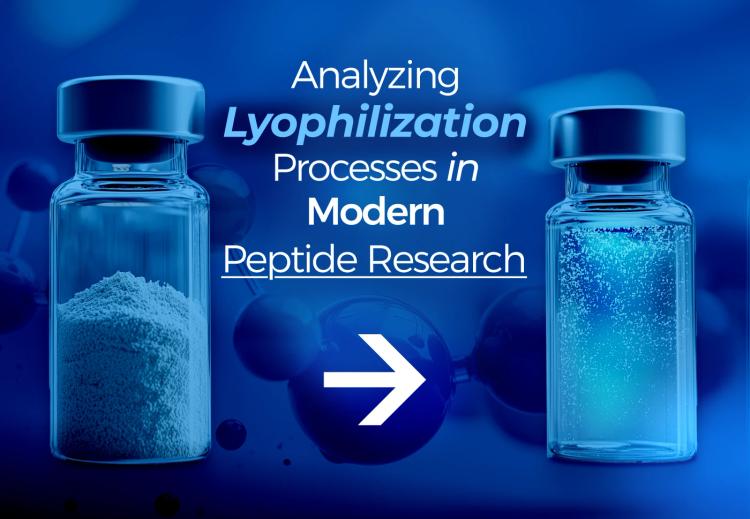
Peptides find application in various situations, be it in research and therapeutic purposes, but its level of stability can vary quite dramatically depending upon its preparation. The two forms that most people come into contact with include lyophilized peptides, which come in packets of dried mass, and those in solution or in its raw, unfrozen form, classified as non-lyophilized peptides. The difference in the forms of peptides is crucial and has significant impacts, as it has serious ramifications regarding its overall application and usage. The truth is, peptides, overall are far more stable if they are lyophilized and not stored in solution form.
Lyophilization-freeze drying of the peptide-removes water from the substance, and its absence has an incredibly stabilizing effect on its half-life. Those that have not undergone this step, whether water-or buffer-based solutions or raw, unmaintained powders, are more fragile and finicky regarding each form-itself and its conditions, its stabilization, and its handling and application.
Stability and Self-life
Stability is, however, where one can really notice the difference between the two forms. Lyophilized peptides will last considerably longer than those that are stored in solution. After the water has been removed by freeze-drying, all the normal degradation processes-hydrolysis, bacterial growth, and all those things that depend upon water-occur at significantly slower rates. A lyophilized peptide, stored under optimal conditions in a sealed vial, refrigerated, and protected from moisture, can remain active surprisingly well into months or years without any significant loss of its potency.
The majority of guidelines include information about storing freeze-dried peptide powders, where such peptides can last several years at -20 C( −4 °F). This is, of course, easy to understand, and it has to do with protecting the peptide from oxidation or hydrolysis, which occur easily in liquid form.
Peptides that are not lyophilized, especially those that are immersed in water or buffer solutions, are not nearly as stable. Solutions, under ideal conditions, can begin to deteriorate in weeks or months if conditions are not strictly controlled. The processes of hydrolysis, oxidation, and even bacterial growth all accelerate in the presence of water. Storage in your fridge, at 4 C, yes, your fridge, despite its usual refrigeration, can still allow your peptide solutions to be nowhere near as stable and deteriorate within that same time frame, depending on your peptide sequence, regardless of conditions. This is why lyophilized peptides are most widely used if your objective is long-term storage.
For purposes of comparison, consider that if stored under optimal at -20 C, a lyophilized peptide could retain over 95% integrity for one to two years or possibly longer. This same peptide, however, when placed in solution and refrigerated, could possibly deteriorate within one to two months. The actual length may depend upon its actual amino acid composition, such as methionine, cysteine, and/or tryptophan, which can be more susceptible to oxidation while in solution, but by all standards, it still appears that lyophilized forms last significantly longer.
Handling and Usage
The processing of peptides in the lab is quite reliant on whether the peptides are lyophilized or not. Lyophilized peptides must be restored to a liquid form before they can be used. This creates the need to add a solvent, such as sterile water, bacteriostatic water, or buffer solution. The restoration of peptides must be handled gently, and most individuals will allow fluid to drip along the sides of the vial and not shake it vigorously, as this can inhibit peptide form. After dissolving, it must be utilized relatively quickly, either by dividing it into aliquots or storing it under conditions described earlier, so it doesn’t begin to deteriorate.
Peptides that are not lyophilized may be ready to use as they come, already in solution form, which, as already stated, is degraded upon reception. To keep those solutions in their optimal form, they need to be stored right away, by cooling or freezing depending on their intended usage, with portion, after reconstitution, already set aside by the scientist in frozen form if not all can be used at once.
Some vendors also categorize “non-lyophilized” peptides as raw material, or powder, which has not yet been lyophilized. Such materials may appear as a mere dusting at the base of an empty vial, and this so because no bulking agents may be present. Nonetheless, such materials would still act similarly to peptides dissolved in solution, despite the powdered form, any trace amount of moisture may lead to degradation.
Presenting Results
From a research standpoint, there are advantages and disadvantages to each form of peptide. Lyophilized peptides last better, making these perfect if long-term storage or shipping is involved. This also means that labs can store them and then spread research over multiple sessions, rather than covering all material in one research session. The major con regarding such forms would be reconstitution, and extra care must be taken to ensure that all of the actual peptide was dissolved. Non-lyophilized peptides, due to their relative instability, are better suited towards short-term approaches or situations in which one single peptide is synthesized and then used immediately.
This form of peptide demands considerable care, such as keeping it under cool conditions while handling it, restricting its time at normal temperatures, and maintaining it free from contamination. Peptides, if in their non-lyophilized form can be saved conducting lyophilization of the liquid by the same research unit.
Conclusion
Scientists speak about peptides as if they are interchangeable, but their method of preparation determines how they are going to act long before any experiments are ever started. Lyophilized peptides are essentially ready as a powder, but this powder is so lightweight that you can literally let it sit for years, and it won’t weaken. The disadvantage to this is that you must re-suspend it yourself, but this is so negligible that most facilities haven’t even thought about it for years, as it makes shipping so much easier.
As for peptides that are not freeze-dried, they are a whole other game altogether. If they are delivered to you already dissolved or indeed any other “wet” form, then you’d better believe that the clock starts ticking the moment they are delivered to you. Peptides in this form are far moodier, more sensitive to temperature change, and they are going to need you to store them in cold environments. You also won’t have as much freedom + to work with them either.
It is important to keep in mind these points when keeping research chemicals to avoid headaches later on. It is also essential to recognize that good storage practices and realistic expectations about shelf-life can contribute to obtaining clean data.
Whether working with a relatively simple peptide, CJC-1295, or something more complex, such as BPC-157/TB-500, the same thing can be applied: handle the research chemicals in a manner worthy of their form, and they’ll act accordingly once they reach the laboratory.
All of our articles are written strictly for educational and research purposes only and are not intended to promote human use of any peptides. If you’d like to learn more about other research peptides, you can check out our article comparing Tesamorelin and Sermorelin:


